Shadow Campaign Tactics: Alleged Monero-Funded Plot Targets Hungarian Opposition Party


As political campaigns increasingly shift into the digital realm, cybersecurity has become a critical factor in modern elections. Beyond traditional messaging and public debates, political actors now rely heavily on online infrastructure, data management systems, and digital platforms. This transformation has also expanded the range of potential threats, with cyber operations—both defensive and offensive—emerging as tools that could influence not only campaign dynamics but also the operational stability of political organizations.
Alleged Cryptocurrency-Funded Access Attempts
An investigation published by Direkt36 and reported by Telex has brought attention to a suspected operation targeting the IT systems of Hungary’s Tisza Párt. According to the report, unidentified actors allegedly offered substantial sums in Monero in exchange for unauthorized access to internal systems.
The case was detailed by Szabó Bence, an investigator at the Nemzeti Nyomozó Iroda specializing in cybercrime. The targeted infrastructure reportedly included multiple platforms connected to the party, such as petition systems, hosting environments, and network-level services.
The financial scale of the alleged offers was significant. The lowest reported bid was equivalent to approximately 24 million Hungarian forints, while the highest reached around 130 million forints. These payments were allegedly intended to secure access credentials or facilitate entry into sensitive systems.
“Money was offered to Gundalf in Monero cryptocurrency to provide access to various IT systems of the Tisza petition platforms.”
Investigation Uncovers Unexpected Evidence
The origins of the case trace back to mid-2025, when Hungary’s Alkotmányvédelmi Hivatal initiated an inquiry that led to house searches involving two IT professionals associated with the party. Although the initial suspicion—related to illegal content—was not substantiated, investigators discovered hundreds of screenshots documenting private communications.
These materials reportedly revealed discussions that suggested the existence of a coordinated effort to infiltrate or disrupt the party’s digital infrastructure. Based on these findings, authorities began examining the possibility of a politically motivated cyber operation.
While the investigation has raised questions about potential organizational backing, including speculation about intelligence-linked involvement, no official confirmation has been made regarding responsibility. Details remain limited, and the case continues to be subject to ongoing scrutiny.
Why Monero?
A central element of the case is the use of Monero, a cryptocurrency designed to prioritize transaction privacy. Unlike Bitcoin, which operates on a transparent blockchain, Monero obscures transaction details, making it significantly more difficult to trace the flow of funds.
Its underlying technologies—such as ring signatures, stealth addresses, and transaction mixing—are specifically engineered to conceal sender, receiver, and transaction amounts. This level of anonymity can make it appealing in situations where discretion is considered essential.
Monero and similar privacy-focused cryptocurrencies have previously been associated with cases involving ransomware payments and efforts to bypass financial restrictions. However, their use in a politically sensitive context introduces additional layers of complexity for investigators.
For law enforcement, such cases present dual challenges: the technical difficulty of tracing transactions and the broader implications of potential political motivations. These factors can complicate both investigative processes and public interpretation of the events.
Outlook
As Hungary approaches its 2026 parliamentary elections, developments like this highlight the growing intersection between cybersecurity and politics. While many aspects of the case remain unresolved, it underscores the increasing importance of protecting digital infrastructure in democratic processes. Going forward, both political actors and authorities are likely to place greater emphasis on resilience against cyber threats, as the boundaries between technology and political competition continue to blur. As Hungary approaches its 2026 parliamentary elections, developments like this highlight the growing intersection between cybersecurity and politics. While many aspects of the case remain unresolved, it underscores the increasing importance of protecting digital infrastructure in democratic processes.
At the same time, online prediction markets are offering a different lens on the election outcome. On Polymarket, a platform where users can place bets on real-world events, participants currently assign a clear lead to opposition figure Magyar Péter, with approximately 64% probability, compared to around 35% for incumbent Prime Minister Orbán Viktor. The total volume of bets exceeds $34 million, reflecting significant global interest and financial stakes tied to the election’s outcome.
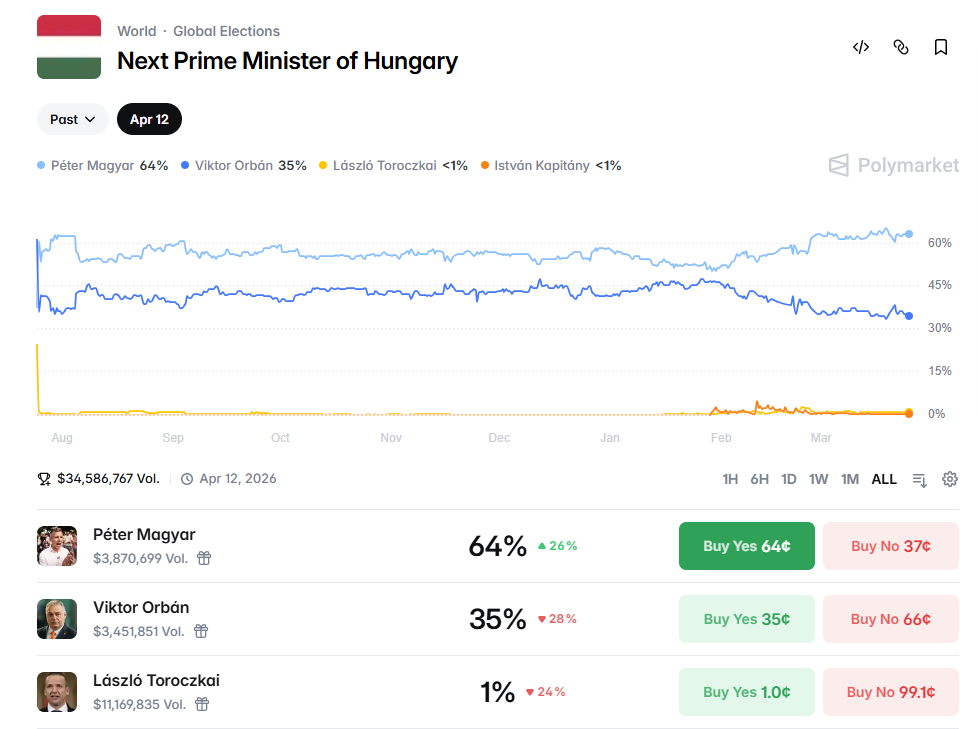
Hungarian Election current standing, source: Polymarket
Going forward, both political actors and authorities are likely to place greater emphasis on resilience against cyber threats, as the boundaries between technology, financial markets, and political competition continue to blur.
Költs kriptóból közvetlenül a Kraken Krak Mastercarddal!
MI A TEENDŐD?- Regisztrálj a Krakenre a linkünkkel.
- Igényeld meg ingyenesen a Krak Cardot.
- Add hozzá Apple Payhez vagy Google Payhez.
- Vásárolj közvetlenül Kraken egyenlegedről akár 400+ kripto- és fiat eszközzel.
- Élvezd a 2% cashback-et a vásárlások után, havi vagy éves kártyadíj nélkül!