
Forex Cashback Programs Explained: How Rebates Reduce Your Real Trading Costs


Forex traders often spend countless hours studying charts and refining strategies while paying surprisingly little attention to the cost of execution itself. Yet every trade carries a price tag in the form of spreads, commissions, and overnight swaps. Over thousands of executions, those small charges quietly compound into one of the biggest drags on long-term performance.
For most retail traders, these costs feel like an unavoidable feature of the market. However, an established corner of the industry exists specifically to reduce them. Cashback rebate services return part of every spread and commission to the trader, regardless of whether the position closes in profit or loss.
Across the forex industry, many active traders rely on these cashback programs to recover part of every spread and commission they pay. The mechanism is simple, transparent, and entirely independent of trading outcomes. Understanding how it works can change the long-term mathematics of trading more than most strategy adjustments.
What Forex Traders Actually Pay
Before examining the rebate mechanism, it helps to understand the cost structure that most traders overlook. Trading costs in forex appear in three main forms, and each applies to every trade you place. Together, they form the operational cost of every position.
- Spreads are the difference between the bid and ask price, charged on standard accounts
- Commissions are charged on raw spread or ECN accounts, usually per lot
- Swap fees are overnight financing charges applied to positions held past market close.
Although individually small, these charges accumulate quickly. A trader executing twenty lots a week can easily pay several thousand dollars in spreads and commissions across a single year. The table below shows realistic cost ranges for the most common account types.
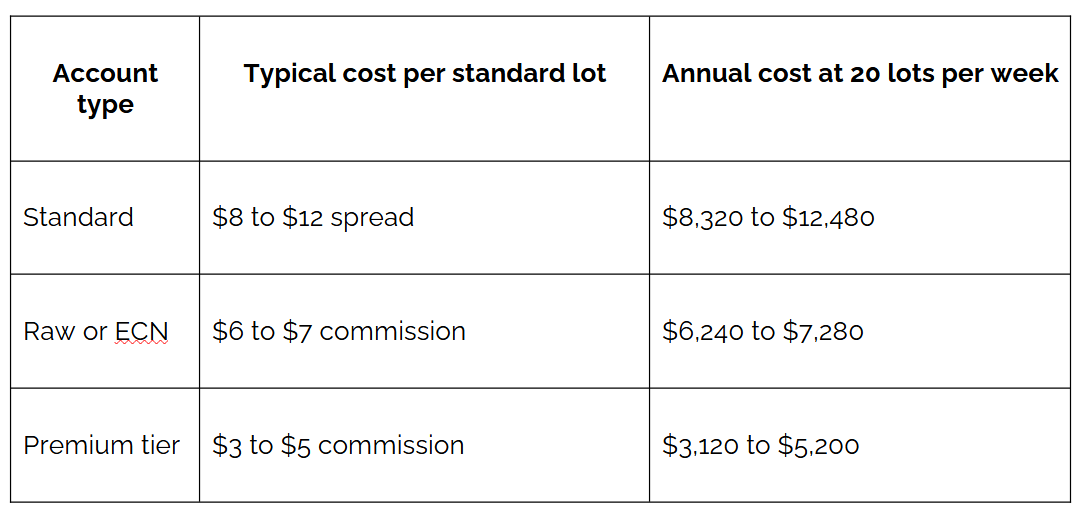
Even with conservative trading frequency, the figures add up to substantial yearly outlays. This is precisely the cost base that rebates target. Recovering even part of those costs noticeably shifts annual results.
How Forex Cashback Programs Work
Cashback rebate providers operate through formal partnerships with regulated forex brokers. When a trader opens an account through a rebate provider, the broker pays the provider a referral commission on every trade placed. The provider then shares a significant portion of that commission with the trader.
Where Does the Rebate Money Actually Come From?
The rebate is not paid out of the trader’s profits, nor does it widen spreads or change execution conditions. Instead, the broker allocates part of its existing marketing and acquisition budget to the rebate provider. The provider then passes most of it back to the client. As a result, the trader recovers money that would otherwise stay with the broker.
How Rebates are Calculated and Paid
Most rebates fall within a clear range that depends on the broker, account type, and lot size traded. For standard accounts, traders typically receive between $1.50 and $3.00 per lot. Some programs offer up to $15 per lot for high-volume activity. Payment frequency varies, with daily, weekly, and monthly schedules being the most common.
Pair Rebates with Real Knowledge
Cashback rebates work best for traders who already understand the markets. The structural advantage they offer compounds most reliably when paired with a disciplined strategy and proper risk control. In other words, knowledge multiplies the value of every rebated dollar.
For this reason, building a strong educational foundation matters far more than chasing higher rebate rates. Working through the most respected forex trading books gives traders the conceptual grounding needed to make rebates genuinely useful. Once that knowledge is in place, the savings from a quality cashback program quietly amplify every disciplined decision over time.
A useful approach is to treat rebates as one element of a wider trading edge. Together with sound technical analysis, risk sizing, and consistent journalling, they contribute to a setup where every advantage compounds in the same direction.
What to Look for in a Cashback Provider
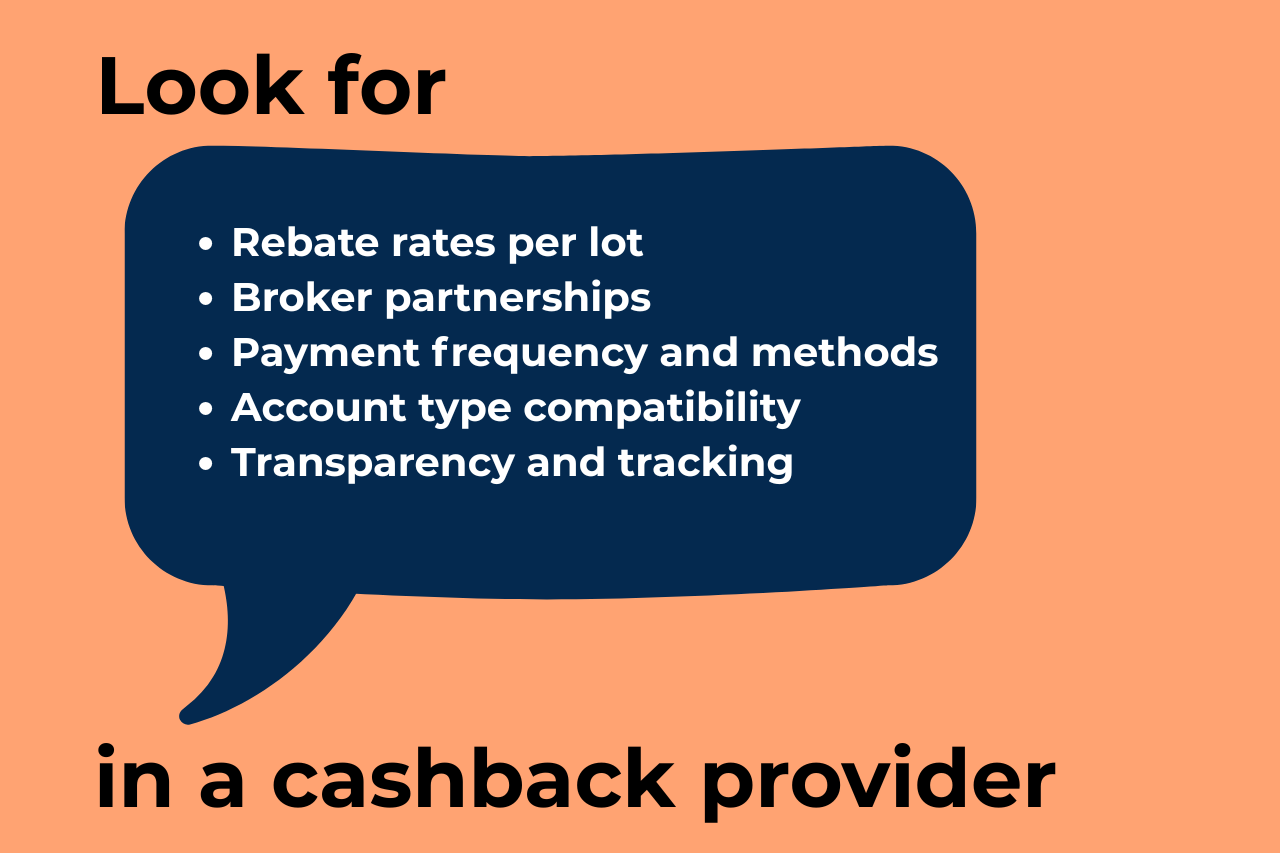
Not all cashback services deliver the same value. The quality of a provider depends on rebate rates, broker compatibility, payment reliability, and transparency. Before signing up, traders should weigh the following criteria carefully.
- Rebate rates per lot. Higher rates mean more savings, although unusually large promises sometimes hide wider spreads or hidden fees.
- Broker partnerships. Quality providers work with regulated, well-known brokers, giving traders access to platforms they would already use.
- Payment frequency and methods. Daily and weekly payouts give traders quicker access to their savings than monthly schedules.
- Account type compatibility. Some providers support both standard and ECN accounts, which matters for traders switching between strategies.
- Transparency and tracking. A clear dashboard showing volume, rebate per lot, and pending payments builds trust over the long term.
Cashback in the Era of Automation
Forex trading has changed dramatically over the past decade as automation has become accessible to retail traders. Modern platforms support expert advisors, copy trading, and increasingly sophisticated artificial intelligence tools that execute orders far faster than any human could. The combined effect of these technologies has reshaped how traders evaluate every cost involved.
Why Automation Magnifies the Value of Rebates
This shift has made cashback programs more valuable than ever. AI-driven trading strategies operate at higher trade frequencies and tighter margins, where every fraction of a pip affects overall performance. Furthermore, automated systems generate consistent volume, which directly amplifies the cumulative value of any rebate scheme.
Practical Implications for Retail Traders
For traders running the algorithmic systems, cashback effectively becomes a built-in cost reduction layer. Many high-frequency strategies that would otherwise look marginal on paper become genuinely viable once rebates are factored into the equation. As a result, automation and rebates increasingly complement one another within modern trading setups.
Should Every Forex Trader Use a Cashback Program?
For most active traders, the answer is yes. The rebate is essentially a refund on costs you already pay, and it requires no change to your strategy or platform. Even occasional traders can benefit if their volume stays consistent enough to make the savings meaningful.
The clearest beneficiaries, however, are those who already trade with discipline and volume. A swing trader paying a few thousand pounds in spreads each year can recoup a respectable share through rebates. A day trader or scalper running automated systems can recover several thousand dollars annually with no additional effort.
Ultimately, cashback programs reward what successful traders already do. They reward consistent execution, prudent risk management, and the patient minimisation of unnecessary costs. By treating rebates as part of the trading plan, traders can quietly improve performance year after year and keep more of what they earn.
***This article is a sponsored guest post. The BitcoinBázis editorial team assumes no responsibility whatsoever for the content and strongly urges all readers to exercise heightened caution when it comes to extremely high-risk investments such as cryptocurrencies, CFDs, tokens, metaverse projects, DeFi, play-to-earn, and ICO/STO/SAFT offerings. Independent research and thorough verification of all claims is highly recommended. Trade, invest, and play responsibly.***